2026-11-03 • oleh Baitul Makmur
At Baitul Makmur Mosque in West Cikarang, there is a scene you may rarely find in other mosques.
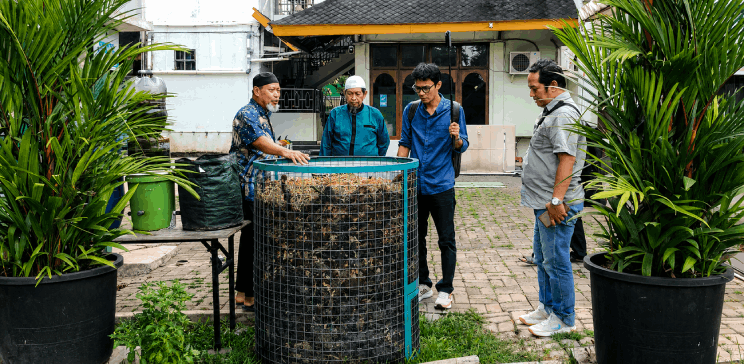
Beside the mosque area, piles of plastic waste are neatly sorted. In another corner, compost containers filled with dry leaves and food scraps are being processed into organic fertilizer. Not far from there, thousands of maggots are actively decomposing organic waste. Meanwhile, used ablution water that would normally go to waste is instead recycled to water plants and fish ponds.
This is the real face of the Ecomosque MUI movement.
Baitul Makmur Mosque is not only a place of worship, but also a center for environmental education for the surrounding community. Here, protecting the earth is seen as part of worship and humanity’s responsibility as caretakers of the planet.
It all started when the mosque management noticed a simple reality: waste was increasing, water consumption kept rising, and environmental awareness in the community was still low.
They then asked themselves, “If the mosque is the center of Muslim community life, why not start the change from the mosque?”
That question became the beginning of a transformation.
Gradually, Baitul Makmur Mosque began implementing the concept of an eco-friendly mosque. Worshippers were encouraged to adopt new habits in their daily lives. Not only coming to pray, but also taking part in protecting the environment together.
One of the first initiatives was the waste donation program. Worshippers were encouraged to bring sorted waste from home, such as plastic bottles, cardboard, paper, and used cooking oil.
At first, many people found it unusual.
Mosques are usually associated with prayer mats and Qur’ans, not with collecting waste. However, the mosque management continuously educated the community that something considered useless could still become valuable if managed properly.
Slowly but surely, people began to adapt.
The children from the Qur’an learning classes became the most enthusiastic participants. Every week, they came carrying used plastic bottles and packaging from home. They learned that protecting the environment is also part of Islamic teachings.
The collected waste was then sorted. Some was sold for recycling, some was processed further, and some was sent to the maggot farming area.
Behind the mosque, visitors can find a Black Soldier Fly larvae cultivation area, commonly known as maggot farming. These larvae help decompose organic waste such as leftover food, vegetables, and dry leaves.
What was once considered smelly waste is now transformed into something useful.
Maggots naturally accelerate the decomposition process of organic waste. The final products can be used as animal feed and organic fertilizer.
The mosque did not stop there. Organic waste was also processed into compost.
Dry leaves from the mosque yard and food leftovers were collected and fermented into natural fertilizer. This fertilizer was then reused for the plants around the mosque.
That is why the atmosphere around Baitul Makmur Mosque feels green and refreshing. Many plants grow beautifully around the mosque area, not only as decoration, but also as a symbol of how waste can be transformed back into life.
The Ecomosque MUI concept can also be clearly seen in the ablution area.
The mosque management realized that hundreds of liters of water were used daily by worshippers. If left unmanaged, a huge amount of water would simply be wasted. This led to the creation of an ablution water recycling system.
Used ablution water is directed into a simple filtration system before being reused to water plants and for other non-consumable purposes.
In addition, water-saving faucets were installed to reduce unnecessary water usage.
Worshippers gradually learned that saving water is not only about reducing costs, but also part of Islamic teachings against excessiveness.
These small changes eventually created a big impact.
The mosque became more vibrant. Worshippers no longer came only for prayer, but also to learn about environmental awareness.
Children grew up with the habit of sorting waste. Residents began to understand the importance of reducing plastic waste and conserving water.
News about Baitul Makmur Mosque gradually spread to many regions. Mosque administrators from different areas came to learn directly about the Ecomosque MUI concept, from waste management and maggot farming to composting and ablution water recycling systems.
This mosque proves that protecting the environment does not always require massive steps or expensive technology.
Sometimes, change simply starts with small actions:
Bringing your own reusable water bottle
Sorting household waste
Turning food scraps into compost
Using water wisely during ablution
And from a mosque in Cikarang came a simple message that continues to inspire many people: that a house of worship is not only a place to draw closer to God, but also a place to learn how to protect the earth together.